Publication

ICRC in Iraq: Key Figures 2025

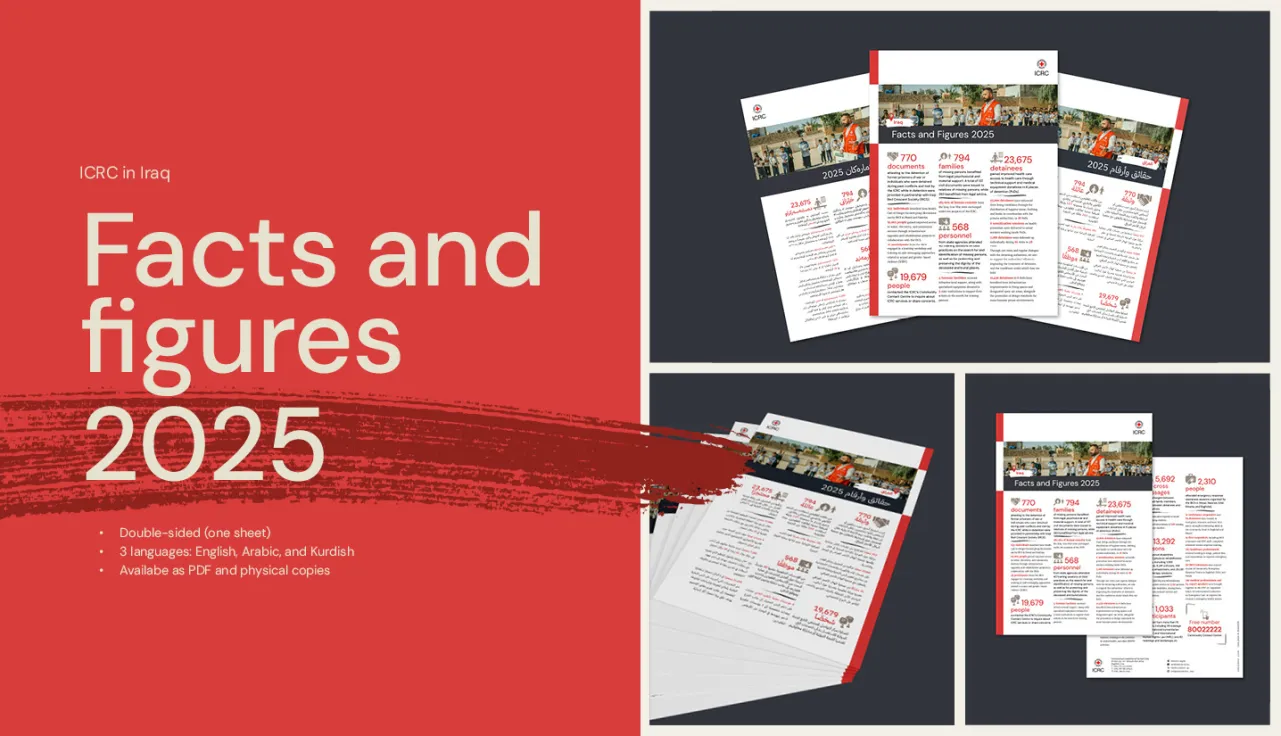
Mockups of the 'Facts and Figures, Iraq 2025,' showing a professional design with the title prominently displayed on the cover.

Each year, the ICRC in Iraq publishes a snapshot of its activities in numbers. Here's a glimpse into our activities in Iraq throughout 2025.
Scroll down to explore some highlights, and you can download the full Facts & Figures report in English from the attachment below.

The ICRC has been present in Iraq since 1980, conducting protection activities and providing assistance to those severely affected by consequences of various cycles of the conflict.

ICRC field officer giving awareness sessions about weapon contamination to school students
23,675

detainees gained improved access to health care through technical support and medical equipment donations in 6 places of detention across Iraq.

37,000

detainees in 18 places of detention have seen their living conditions enhanced through the distribution of hygiene items, clothing and books in coordination with the prison authorities.

5,692

Red Cross Messages were exchanged between separated family members, mostly between detainees and their relatives. Additionally, the fate and whereabouts of 517 missing persons were clarified. 

794

families of missing persons benefited from legal, psychosocial, and material support, while a total of 137 civil documents were issued to relatives of missing persons, and 263 more benefitted from legal advice.

13,292

persons with physical disabilities received physical rehabilitation services, including 1,065 protheses, 6,291 orthoses, 319 adaptive wheelchairs, and 26,091 physiotherapy sessions.

183

sets of human remains from the Iraq-Iran War were exchanged under the auspices of the ICRC.

9,149

people including families of missing persons and persons with physical disabilities, strengthened their livelihoods through cash assistance for agriculture, livestock activities, small businesses, and other livelihood projects.

19,065

people gained improved access to water, electricity, and community services through infrastructure upgrades and rehabilitation projects in collaboration with the Iraqi Red Crescent Society (IRCS).

932

individuals benefited from Health Care in Danger-focused group discussions ran by IRCS in Mosul and Nasiriya. Additionally, 35 participants from the IRCS engaged in a learning workshop and training on safe messaging approaches related to sexual and gender-based violence (SGBV).

2,310

participants attended emergency response awareness sessions organized by the IRCS in Mosul, Nasiriya, Erbil, Ninawa, and Baghdad.

English

ICRC_Newsletter_A4_FnF25_ENG.pdf
PDF file
1.24 MB