Colombia: After the earthquake, Chocó’s schools face a long recovery

At 7:36 a.m., teacher Rosalba* and her seven students, aged seven to ten, held each other and cried outside the school as the rumble of the earthquake that shook western Colombia in early August finally began to subside.
“We ran to the patio, looking for the safest place we could find, watching that the electric lines wouldn't fall on us – that was the biggest risk here,” Rosalba recalls. Next to them the remains of the school's kitchen lay scattered across the ground.
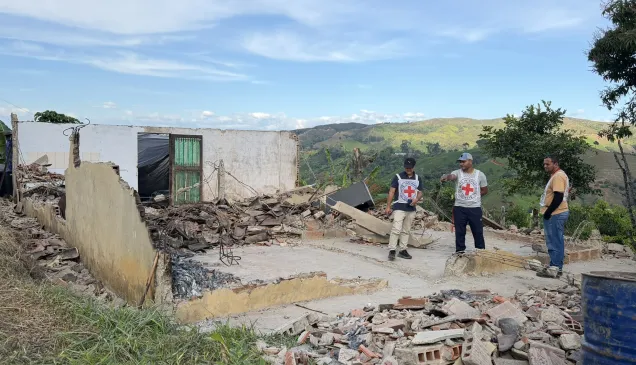
The events of that morning have left their mark on San José del Palmar, a municipality of nearly 1,000 km² in the humid Pacific coast region of Chocó. Two weeks on, debris still litters the landscape and classrooms remain empty – a visible sign of hardship in a place already strained by decades-long conflict, and where infrastructure and institutional presence remain limited.
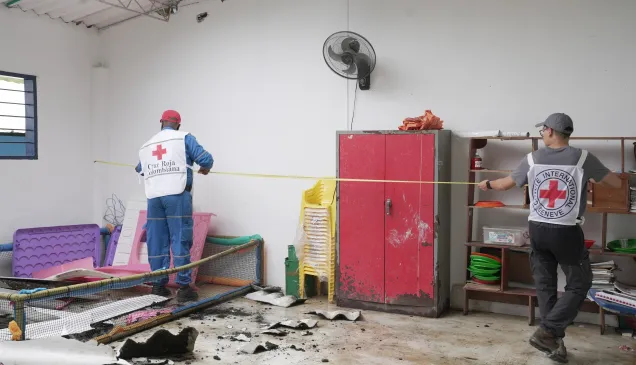
In the days since the earthquake, the International Committee of the Red Cross (ICRC) has been on the ground, working alongside the Colombian Red Cross – which has led the Movement's response to the earthquake in the country – and residents to assess the damage and understand what support is most urgently needed.
Day by day the community is trying to resume its routine: clearing hazardous debris, repairing homes and rebuilding a sense of normalcy after the shock of the quake. Schools, however, are proving harder to reopen and most remain unable to receive students.
At another school, about 30 minutes away by a narrow dirt road, Principal Consuelo walks the empty halls, describing how evacuation drills originally planned for an emergency had helped prepare her students for the moment the quake struck, too. When the ground shook, they filed out calmly without incident.
In these communities, the school is not only a place of learning. It is an informal daycare, a community centre and one of the few places that keeps children and young people away from the risks that can come with being out of school in an area where several armed groups are present.
"The school is a safe space for the students because there we are guiding them and keeping them company. But now they are all worried, because there's still no hope of resuming activities," Consuelo says, describing how hard it is for the community to have to wait for outside assessment before students can resume their classes. Without a formal technical evaluation, no parent will risk sending their children back to a building that might collapse.
Access to rural Chocó is constrained, and in some hard-to-reach communities, residents had begun repairing damaged roads and water systems themselves while awaiting help from the outside. “We don't know anything at all – you are the first ones to come here. Nobody has come to see us, or even called,” says Wilson, the president of the local community action group – the Junta de Acción Comunal (JAC) – in a rural village visited by the ICRC.
Still, local institutions can quickly be overwhelmed by an emergency of this scale. Here it struck at the heart of communal life: “There are 55 children who study here and the school was badly damaged. Luckily, it wasn't yet time for class or there might have been injuries,” Wilson says.
“The earthquake was felt very strongly – as you could see, it affected a big part [of our village]: the school, the health centre, even a community building we were working on.”
The ICRC has worked in rural Chocó for years, supporting communities affected by the country's armed conflict – responding to their most urgent needs and staying close to their everyday reality. That proximity is what has allowed ICRC teams to respond quickly to the earthquake, assessing health needs alongside residents and inspecting school infrastructure in communities already living through the impact of conflict in the region.
Across San José del Palmar's rural area, ICRC teams have identified at least seven rural schools still unable to resume classes two weeks on. For Consuelo and the families who depend on her, that presence provides a sense that they are not facing the consequences of the earthquake alone, and that concrete answers, not just further uncertainty, are on the way.
* Names have been changed to protect the identities of those interviewed due to the security situation in the area.


Photo: Germán Pérez