Earthquake in Colombia: The ICRC supports the rehabilitation of essential community infrastructure

The earthquake that occurred on 10 August exacerbated the humanitarian needs of communities that were already grappling with consequences of armed conflict in Colombia. In rural areas of the departments of Chocó and Valle del Cauca, the damage caused by the earthquake compounded existing challenges, including years of displacement, confinement, explosive hazards and difficulties in accessing essential services such as water, health care and education.
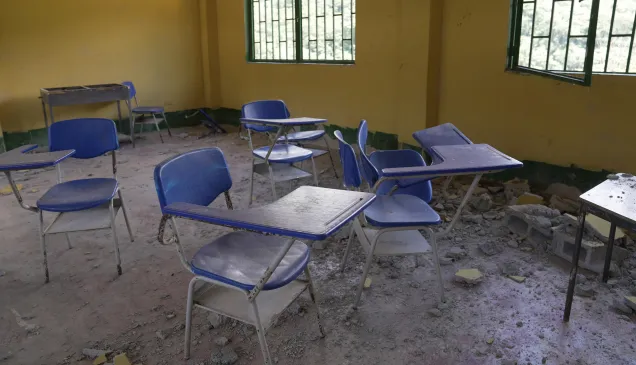
The earthquake affected a large portion of the population, including the school, the health centre and a construction project we are organizing (together with the community). “Now we have to figure out how we’re going to rebuild, because this is a very challenging area,” said Alexis Mosquera, president of the community action board in a rural area in Nóvita, Chocó.
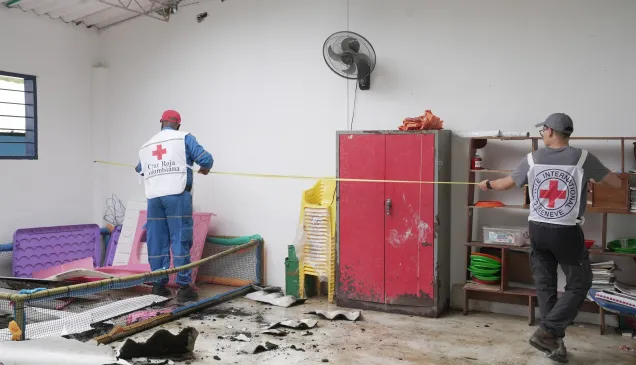
Based on assessments carried out in coordination and in collaboration with the Colombian Red Cross, the International Federation of Red Cross and Red Crescent Societies (IFRC) and the relevant authorities, the ICRC has defined a two-phase response for the recovery of community infrastructure: an initial emergency recovery and the rehabilitation of medium- and high-complexity infrastructure. The initiative focuses on priority areas in Chocó and Valle del Cauca.
“When a disaster strikes communities that are already grappling with the consequences of armed conflict, their needs multiply. Our response aims to help restore essential services and support the hardest-hit communities, particularly in rural areas where recovery presents greater challenges.” Olivier Dubois. Head of the ICRC Delegation in Bogotá.
The importance of community infrastructure for post-emergency recovery
For communities affected by armed conflict, a school, a health post, a water system, or a community space fulfil essential functions in daily life and, in some cases, can also help reduce risks specific to areas affected by conflict.
In addition, if a community water supply system is disrupted, families may be forced to travel to find other sources of water, which can create additional difficulties and increase their exposure to risks related to explosive hazards and restrictions on movement.
For this reason, the ICRC plans to prioritize the restoration and improvement of essential community infrastructure in areas historically affected by armed conflict that were impacted by the earthquake on 10 August.
A phased recovery response
It will take time for these communities to recover. The ICRC’s response, which is expected to continue for six to nine months in Chocó and Valle del Cauca, includes:
Phase 1: Initial recovery: materials for basic repairs and improvements in seven community spaces, with a view to helping to restore essential services.
Phase 2: Infrastructure rehabilitation and restoration: This includes moderately complex projects to rehabilitate roofs, kitchens, school dining areas and other community spaces, as well as to restore educational facilities and other strategic community infrastructure that sustained significant damage.
One month after the earthquake, the ICRCʼs response is ongoing
One month after the earthquake, the ICRC, in coordination with the Colombian Red Cross and relevant authorities, has made progress in its efforts to meet basic needs and strengthen essential services in priority rural communities. Assistance has focused on families whose homes were destroyed or damaged, and on households struggling to access food and other essential goods due to damaged roads and disrupted livelihoods.
Access to safe water and building materials
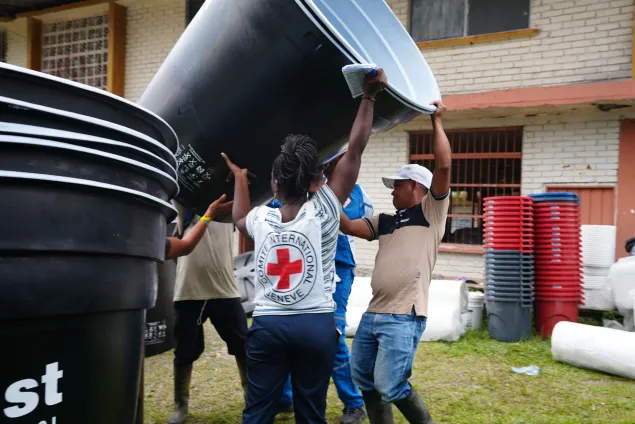
- More than 2,000 families have received support to facilitate the storage of and access to safe water, as well as construction materials for repairing community infrastructure, including a health post.
- Materials for repairing educational facilities in 10 communities that serve 755 students.
Health
- Fifteen health clinics in Chocó received rapid-response kits (PIRs), consisting of medications and medical supplies to strengthen their ability to respond to their communities’ needs.
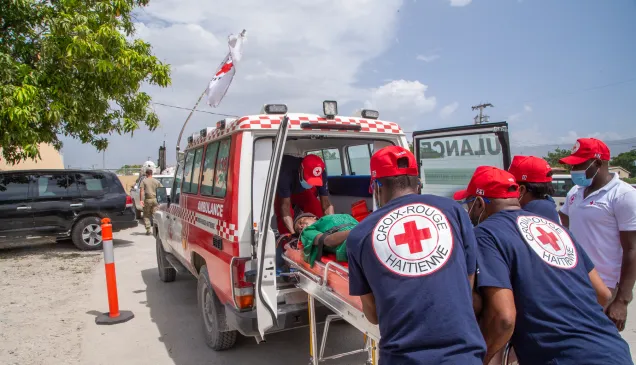
- Fifteen medications and rapid-response kits (PIRs) were delivered to the Colombian Red Cross to strengthen its response capacity in Chocó and Buenaventura. The kits include nine first-aid kits, three emergency kits, and three infusion kits, with supplies to treat between 400 and 700 injured people, depending on their needs and the type of care required.
Food security
- 7,495 people (1,759 families) received support to meet their food needs.
- 7,037 hygiene items and 1,127 shelter kits, which include items such as sheets, mats, blankets and kitchen utensils.
- Based on the needs identified, cash assistance was provided to help 400 people buy food, 40 people resume their livelihood activities, and 168 people cover temporary housing costs
A coordinated and complementary response
“Humanitarian action is most effective when efforts are coordinated. In this case, the coordination between the ICRC and the Colombian Red Cross allows us to contribute, through our respective roles and presence on the ground, to meeting the needs of the affected communities.” Olivier Dubois, Head of the ICRC Delegation in Colombia.
The Colombian Red Cross’s presence on the ground, its teams, and its volunteers have been key in providing a humanitarian response that is close to the affected communities, as well as in identifying needs and tailoring actions to the conditions and priorities of each community.
Meanwhile, the ICRC’s sustained presence in these areas, built through years of work with communities and dialogue with the parties to armed conflicts, facilitates access to remote locations and allows for a first-hand understanding of the needs of their residents. The ICRC’s work is carried out in accordance with the principles of neutrality, impartiality and independence, which enable the ICRC to maintain a dialogue with the different parties and continue its humanitarian work.