Donetsk: The quiet that conflict takes away

Below is a story from Donetsk. A simple question and a simple answer explains the silent toll of conflict:
Is it quiet in your village now?
No, it isn’t quiet…
Olga Andriivna is 85, and she crosses her street in Mykilske on two walking sticks, a street that, not long ago, was too dangerous to cross at all.
“We have a monastery,” she says. “If it weren’t for the monastery, I don’t know how we would have managed.”
When all other options fail, a place like this becomes central to a community’s survival. Like all sacred spaces, it gives people a sense of meaning, belonging, and a reason to hope. That is precisely why international humanitarian law grants specific protection to such sites not merely as roofs overhead, but as vital living heritage, the very glue a community needs to survive and eventually rebuild.
Olga shares her story. Her son is not there with her. He is in the hospital. Her age and the ongoing hostilities make it too dangerous for her to reach him.
A neighbour’s house was hit. Her son ran outside to check if anyone survived. A second shell landed right after the first. Shrapnel passed by his carotid artery. Olga tells it plainly, the way people do once dread has worn smooth from repetition. But underneath, an act of basic decency nearly cost a life. That’s one of conflict’s quieter cruelties: it punishes the instinct to help.
“Where could I possibly go?” Olga asks.
“There was no one left. I was the only person on the whole street.” She cries, then adds, almost apologetically: “I’ve been through so much, God forbid anyone should have to endure it.”
Then the question with no answer: “Where am I supposed to evacuate to when I’m already 85 years old?” It isn’t rhetorical, it is logistical complexity stated as despair. Displacement demands mobility, stamina, somewhere to land. Age has already taken those away.

Having spent her whole life in Mykilske, Olga Andriivna remembers the days when the city was alive with sounds of children and cheerful laughter.
Sofas smashed, wardrobes destroyed, both couches broken, propped on bricks, to be used for sleeping. “The house is badly damaged. But other than that, we’re managing,” says Olga. Not resignation, not false cheer, just what survival sounds like when ‘managing’ comes to mean still breathing, still finding a place to lie down.
Her story is part of a pattern seen in every protracted conflict: the elderly are particularly affected by the consequences of the ongoing conflict. Their options are fewest, they can’t easily leave or start over, and the people they lean on are often the first ones conflict isolates them from.
Harder to see is the mental toll of not knowing when it will end. Communities don’t get to grieve and rebuild in sequence, they grieve while it’s still happening, with no certainty the walls will stand tomorrow. Even when the guns fall silent, the pain of unresolved struggles remains, as the echoes often do not fade away immediately, but with time.
Hopefully.
For now, neither the village nor the memories are silent.
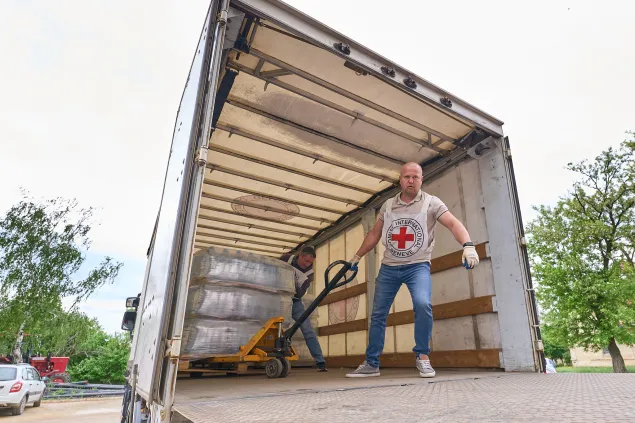
Distribution of humanitarian assistance in the village of Mykilske. Together with our operational partner in Donetsk, we delivered humanitarian assistance to residents of Mykilske, including drinking water, food and hygiene items.
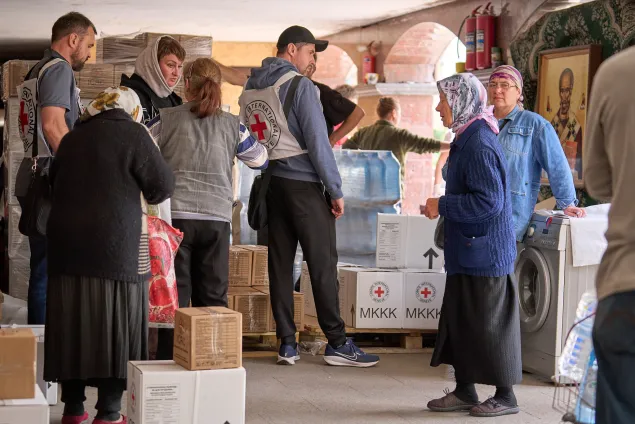
The village has been heavily affected by hostilities and currently has no centralised water supply or electricity. This assistance helps residents avoid travelling to neighbouring communities for essential goods.
Olga’s street is just one of many streets in Mykilske, where civilians face the same hard reality. The international armed conflict between Russia and Ukraine continues to strip people of their homes, their sense of safety and the foundations of normal life. Along the front line, damaged infrastructure has left entire communities struggling to access food, clean water, heating and medical care. Every day this conflict continues, the toll grows for everyone caught in it.
This story is just one of many we have witnessed in this armed conflict. To respond to the needs of people like Olga in communities close to the front line, the ICRC works alongside its operational partners in Donetsk and Luhansk to reach people enduring harsh conditions. To address their immediate needs and help restore their dignity, we provide tarpaulins, roofing materials, food, and cash assistance.
In the first half of 2026, people living in conflict-affected communities of Donetsk and Luhansk were supported by the ICRC and its operational partners:
- Almost 8,600 people across 12 settlements received essential materials such as tarpaulins, plastic sheets and wooden planks to facilitate the quick and temporary repair of their damaged houses. More than 80 tonnes of supplies were distributed across Donetsk region, providing families with immediate shelter and protection from harsh weather conditions.
- More than 1,500 individuals from about 500 private households received around 1,150 tonnes of construction materials, including roofing sheets, timber, bricks and sand to repair their damaged homes in 14 locations across the Donetsk region.
- Over 500 individuals living in former front-line areas, including Travneve, Gladosove, Krynychne, Krasnohorivka, Mykilske, were assisted monthly with food and hygiene parcels.
- Some 120 vulnerable families had their homes repaired, including the installation of PVC windows to improve their living conditions across 5 locations in Donetsk region.
- More than 70 households with recently damaged houses in Berdyanske, Satrana, Debatlseve and Talakivka received cash assistance to support recovery efforts and improve living conditions.