ICRC holds exhibition in Seoul to mark the 60th anniversary of Republic of Korea’s accession to the Geneva Conventions

ICRC (Seoul): The International Committee of the Red Cross (ICRC) is holding an exhibition in central Seoul to mark the 60th anniversary of Republic of Korea’s accession to the Geneva Conventions.
It was in fact in 1903 - so, more than 120 years ago - that Korea joined the First Geneva Convention. In doing so, Korea became one of the earliest non-European States to commit to what was then the emerging system of humanitarian law.
When we consider the historical context, this decision becomes all the more remarkable. By 1903, Korea had been open to foreign powers for less than three decades, following centuries of isolation policy. At the same time, the country was navigating an increasingly turbulent period marked by intense geopolitical rivalry and mounting external pressure.
Against this backdrop, Korea's decision to join the First Geneva Convention reflected considerable foresight, determination, and courage, as well as a strong sense of responsibility for humanity — the very qualities that gave rise to the Geneva Conventions themselves.
Titled "Wars Have Limits," the exhibition is currently underway in the heart of Seoul. It is jointly organized by the ICRC and the Seoul Museum of History, in cooperation with the Embassy of Switzerland in the Republic of Korea, and sponsored by the Ministry of Foreign Affairs and Korean Red Cross.
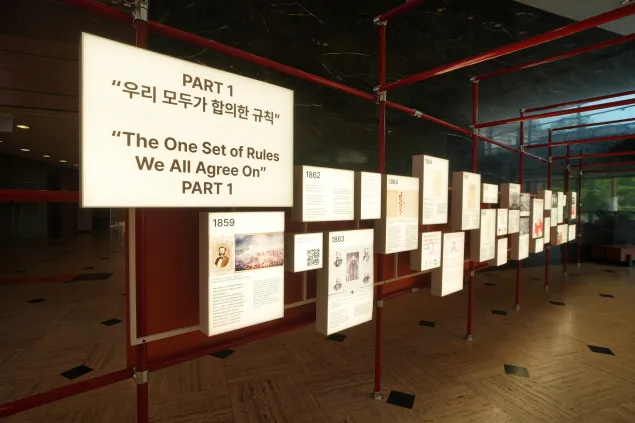
The exhibition also highlights the historical significance of the Korean War in the development of international humanitarian law.
The Korean War was the first major armed conflict since the revision of the Geneva Conventions in 1949. However, the 1949 Geneva Conventions came into force on 21 October 1950—almost four months after the Korean War broke out. Furthermore, they had not been acceded or ratified by the main parties to the war to any extent: the Republic of Korea(ROK), the Democratic People’s Republic of Korea (DPRK), the United States, the Soviet Union, and China. So in that sense, from a treaty law perspective, the 1949 Geneva Conventions did not apply to the Korean War.
Nonetheless, a day after the Korean War broke out, the ICRC sent two identical telegrams to the governments of both South and North Korea, offering services and urging both parties to comply with the humanitarian principles enshrined in the Geneva Conventions.

The exhibition's centerpiece is a light tower that illustrates how international humanitarian law is being challenged. The message is told a curated collection of human-centered photographs paired with firsthand testimonies, connecting visitors directly with the faces and voices of men, women, and children enduring conflict.
It’s as if we were born into flight. I fled, my children fled, and now their children are fleeing too,
reads a poignant quote from Saada in Lebanon.
Beside it, a quote from Hanan in Yemen echoes a sudden, shattered peace:
We had a newborn baby girl. We were deeply happy. Then everything changed. That day, my life came to an end. I lost my husband, my work and my house.
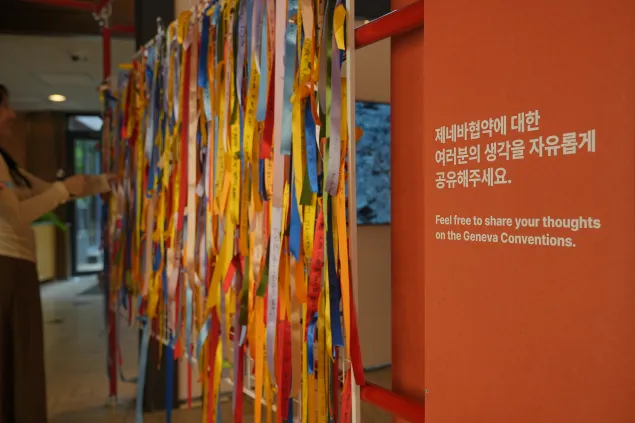
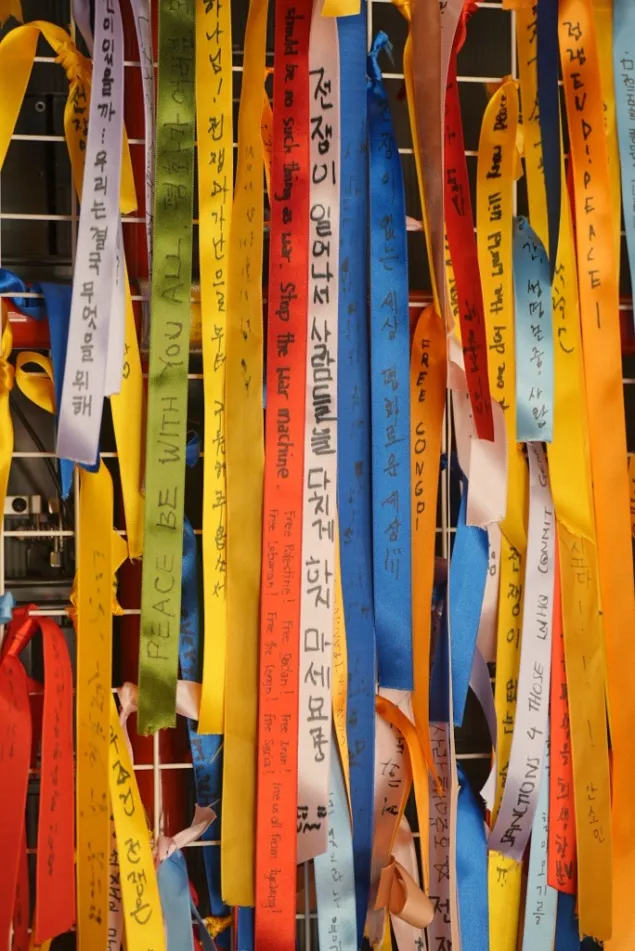
As seen in the photographs, there is a “Ribbon Wall” where we invite the visitors to leave a message in a ribbon about their thoughts on Geneva Conventions. What appears to be a child’s neat, carefully printed handwriting reads “Please do not hurt the people in war.”
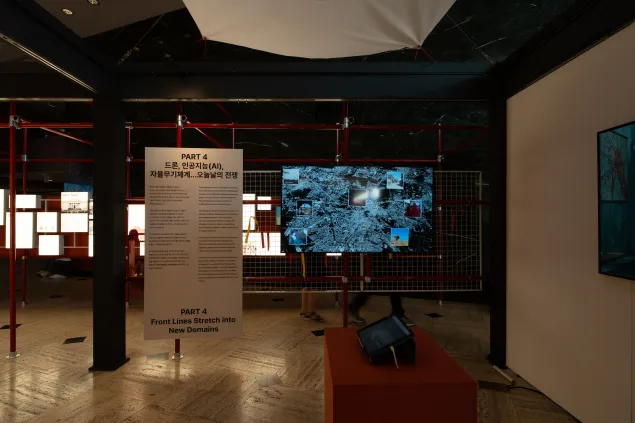
The exhibition also introduces the visitors to information about the ICRC’s work in the area of new means and methods of warfare, such as AI. There is also a section where the Embassy of Switzerland in the Republic of Korea, the partner for the exhibition, introduces how Geneva is the hub for international multilateralism. About 60 people from the government, the diplomatic community, academia, and the media came to attend the exhibition’s opening ceremony on 4 June. The exhibition runs until 9 August.
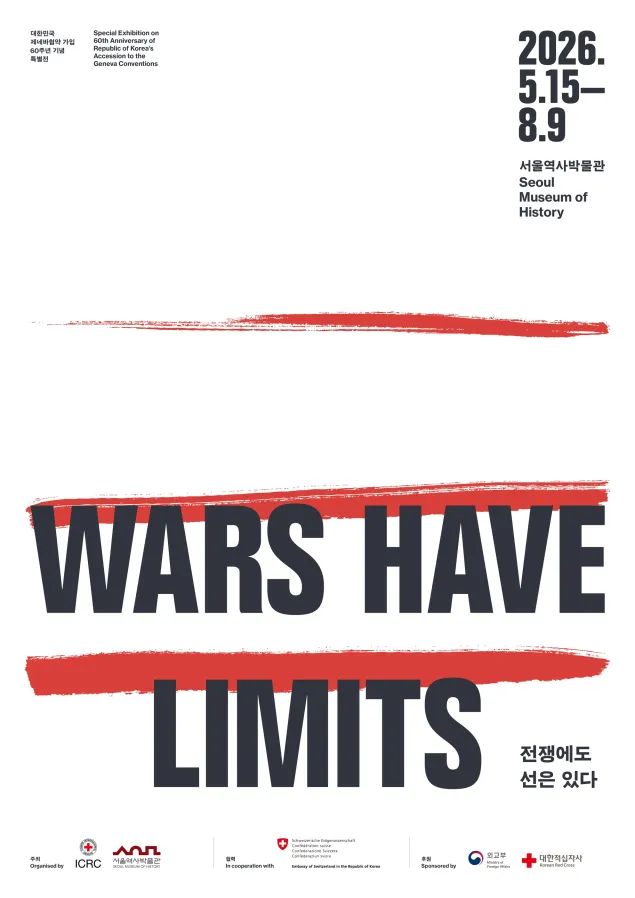
For more information on ICRC activities in Republic of Korea, visit Republic of Korea | International Committee of the Red Cross
For those wishing to learn about the history of ICRC and Korea, you can learn more on Historical Timeline — ICRC, Geneva Conventions and the Republic of Korea | International Committee of the Red Cross
For Korean speakers, visit the ICRC Korean website at 국제적십자위원회 and at our Facebook page.