Putting Humanity First: Symposium Explores Responsible Use of Technology in Humanitarian Action

On December 5, 2025, the Symposium on the Responsible Use of Technology in Humanitarian Action, co-organized by the International Committee of the Red Cross (ICRC) and the Center for International Security and Strategy (CISS) of Tsinghua University, concluded in Beijing after two days of in-depth discussions on how emerging technologies including artificial intelligence (AI) can be applied humanely, ethically, and responsibly in humanitarian contexts.
The symposium brought together around 80 distinguished scholars, humanitarian practitioners, and technology experts from UN agencies, international organizations, universities, think tanks, and industry, representing both domestic and international perspectives.
The symposium in Beijing was part of a series of global, regional and thematic symposiums organized by the ICRC to bring diverse perspectives on the use of technology in humanitarian field aiming at addressing the risks and finding innovative solutions to the longstanding humanitarian issues.
Balancing opportunities and risks
As artificial intelligence and other emerging technologies are rapidly advancing worldwide; while improving efficiency, they also raise growing concerns over risks related to the digital divide, algorithmic bias and data breaches.
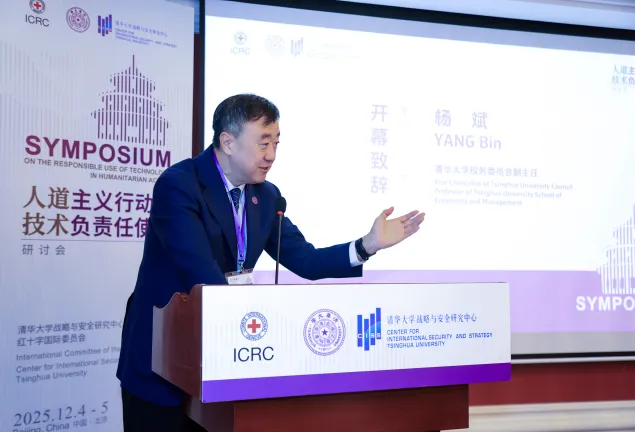
YANG Bin, Vice Chancellor of the Tsinghua University Council, delivers opening remarks.
“Throughout the long arc of human civilization, technology has always been a driving force for social progress. Yet precisely because technology carries so much promise, we must ensure it is used responsibly,” emphasized YANG Bin, Vice Chancellor of the Tsinghua University Council, during the opening session moderated by Xiao Qian, Deputy Director of CISS.
He highlighted China’s efforts in advancing AI ethics, governance, and technology-for-good initiatives, both nationally and internationally, while expressing confidence that the symposium would provide a platform for participants to exchange insights, share experience, and build consensus on the responsible use of technology in humanitarian action.
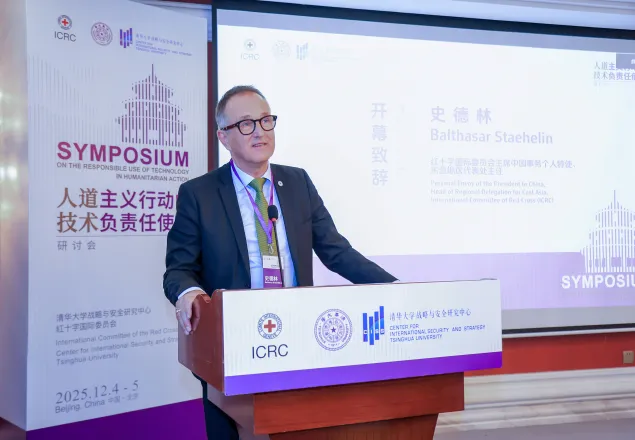
Balthasar Staehelin, Personal Envoy of ICRC President to China and Head of the ICRC Regional Delegation for East Asia, delivers opening remarks.
The ICRC, as a neutral humanitarian organization, has acknowledged that the rapid development of AI is creating significant opportunities, as well as new risks, for the humanitarian sector. In 2024, the ICRC established its AI Policy to guide the exploration of AI in supporting its humanitarian mission. The policy is designed to ensure that all use of AI across the organization remains responsible, safe, coherent, and most importantly, human centred.
“Together, we hope to identify potential technological solutions to support humanitarian action and foster dialogue and progress on their responsible development and use for the common good,” stressed Balthasar Staehelin, Personal Envoy of ICRC President to China and Head of the ICRC Regional Delegation for East Asia, in his opening remarks.
China’s leadership in technology offers immense opportunities for humanitarian action. By working together, we can develop solutions that prioritize humanity, safety, and dignity, while addressing the risks of emerging technologies.
Diverse perspectives
The keynote speakers offered complementary perspectives on ethical, safe, and effective use of technology in humanitarian work.
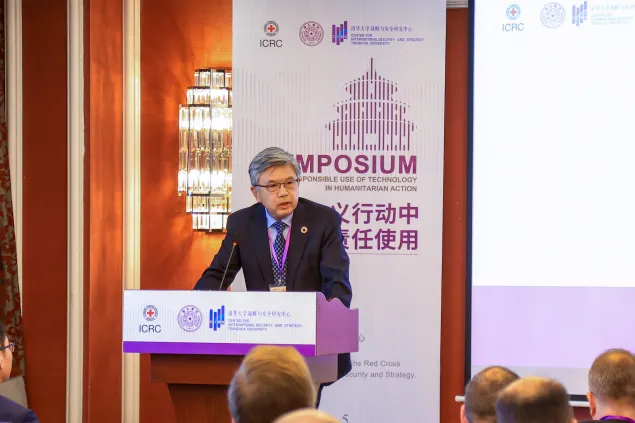
Gong Ke, Executive Director of the Chinese Institute of New Generation Artificial Intelligence Development Strategies.
Gong Ke, Executive Director of the Chinese Institute of New Generation Artificial Intelligence Development Strategies, outlined practical measures for responsible AI in humanitarian action, including prioritizing applications that address urgent humanitarian needs, ensuring inclusive and representative datasets, establishing global incident reporting and learning systems, and creating accountability mechanisms.
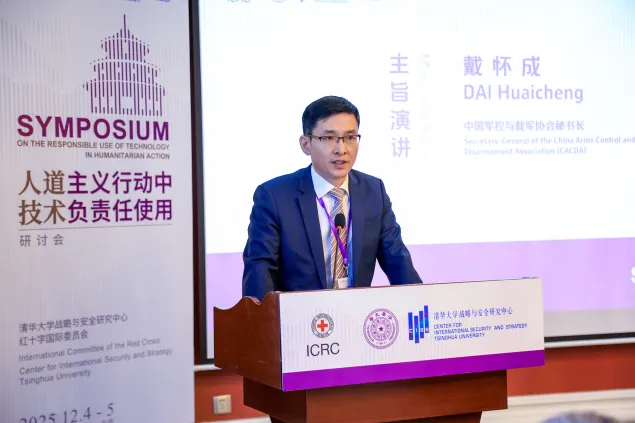
Dai Huaicheng, Secretary-General of the China Arms Control and Disarmament Association (CACDA).
Dai Huaicheng, Secretary-General of the China Arms Control and Disarmament Association (CACDA), drew on China’s White Paper “China’s New Era Approach to Arms Control, Disarmament, and Non-Proliferation,” which for the first time outlines China’s national policies on outer space, cyberspace, and the military use of artificial intelligence. He emphasized that the white paper aligns with the symposium’s theme of responsible technology use, highlighting that the use of AI in the military domain must comply with international humanitarian law and other relevant international laws.
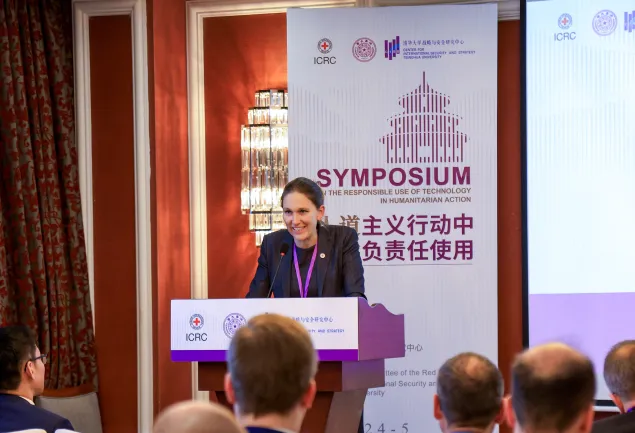
Els Debuf, Head of the ICRC’s Global Cyber Hub in Luxembourg.
Els Debuf, Head of the ICRC’s Global Cyber Hub in Luxembourg, underscored the ICRC’s commitment to a principled digital transformation through its institutional strategy, Artificial Intelligence Policy, and the International Red Cross and Red Crescent Movement resolution on protecting civilians from digital harms in armed conflict. Stressing on closer collaboration between humanitarian and tech sectors, she called for the integration of humanitarian ethics from the design phase of new tech products and tools because adapting them at a later stage makes the integration complex and difficult.
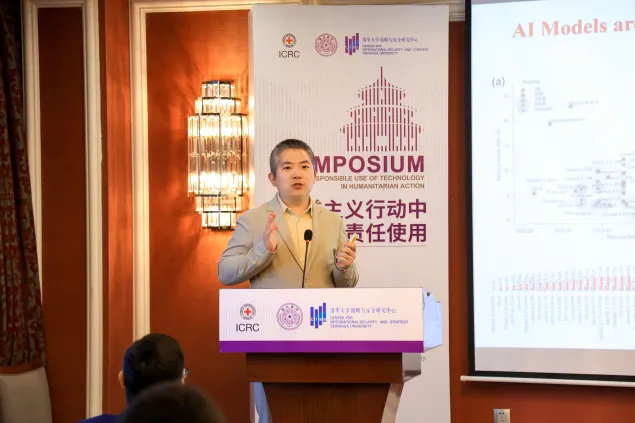
Zeng Yi, Founding Dean of the Beijing Institute of AI Safety and Governance.
Zeng Yi, Founding Dean of the Beijing Institute of AI Safety and Governance, warned that AI systems are growing more powerful without corresponding safety improvements. Citing global studies, he highlighted the vulnerability of large AI models to attacks, including in high-risk scientific and military domains, and stressed that absolute safety can never be mathematically guaranteed. He called for clear international “red lines” on unacceptable AI uses and urged coordinated global action to prevent catastrophic risks and protect international peace and security.
Addressing challenges and exploring solutions
Following keynote speeches, the opening panel explored the challenges and opportunities of emerging technologies in humanitarian action and laid the foundation for four thematic roundtables.
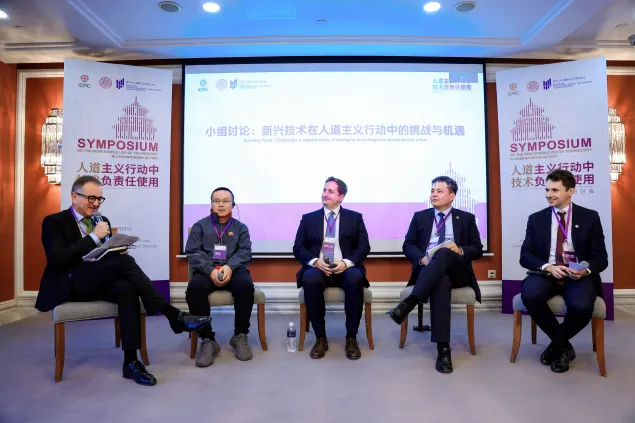
Balthasar Staehelin (left) chaired the opening penal. Panelists Chen Qi (Tsinghua University), Andrea Cavallaro (Swiss Federal Technology Institute of Lausanne), Xiaodong Lee (Fuxi Institution), and Blaise Robert (ICRC Global AI Advisor) presented scenarios illustrating both the promise of digital tools for crisis response and the ethical, governance, and security challenges they entail.
The four roundtables addressed critical dimensions of technology in humanitarian action. The first focused on responsible AI, examining governance models, ethical frameworks, and opportunities for cross-sector collaboration to maximize benefits while mitigating risks, particularly for vulnerable populations. The second explored “Tech for Good,” discussing how innovations and social responsibility initiatives from leading tech firms can be applied ethically and sustainably in fragile contexts. The third centered on AI safety and security, reviewing practical safeguards, risk mitigation recommendations, and responsible use of AI in humanitarian action. The fourth examined digital trust, exploring ways to build, maintain, and strengthen confidence in digital services and technologies, especially in humanitarian operations.
Across all sessions, participants emphasized the need for robust governance, operational best practices, and collaborative approaches to ensure technology supports principled and effective humanitarian action.
Looking Ahead: Human-centered technology
While opinions vary, one understanding shared by almost all participants is that technology, when applied responsibly and in line with humanitarian principles, can enhance the safety, dignity, and resilience of people affected by conflict and crises. By placing humanity at the center of design and deployment, innovation can genuinely support affected communities while minimizing ethical and operational risks, making technology a practical and principled tool for humanitarian action.
The symposium was the first technology-focused event organized by the ICRC in China, one of the world’s most important innovation hubs. It was part of a broader effort to strengthen dialogue and cooperation between the ICRC and China’s technology community. It further strengthened the Chinese community’s understanding of the ICRC and humanitarian contexts, while also bringing the ICRC closer to China’s technology community.