“Humanitarian challenges today are global, and so must be the solutions”

As technologies reshape conflict and humanitarian action across borders, today’s humanitarian challenges are inherently global, demanding dialogue that brings together diverse perspectives and expertise. The article highlights key insights from the Symposium on the Responsible Use of Technology in Humanitarian Action, held in Beijing in December 2025, presenting shared dilemmas, emerging challenges, and avenues for continued engagement.
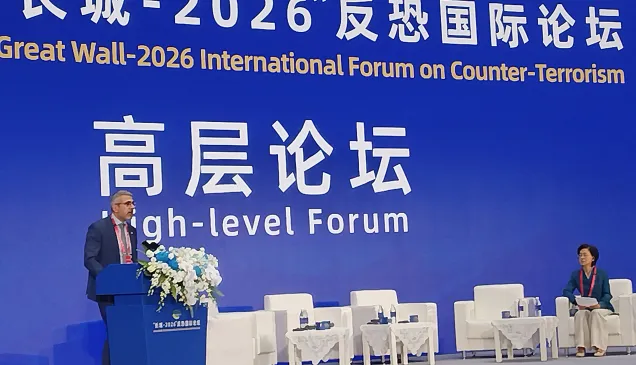
“Humanitarian challenges today are global, and so must be the solutions” said Gong Ke, Executive Director of the Chinese Institute of New Generation AI Development Strategies. Part of his opening remarks during a sunny, brisk winter morning in Beijing, Gong Ke spoke to the importance of responsible AI safeguards in humanitarian action, from prioritizing urgent needs to ensuring inclusive datasets. The event was situated a few kilometers away from Tsinghua, one of the leading engineering and technology university in China, and Zhongguancun Science Park, the country’s leading tech and innovation hub.
Co-organised by the ICRC’s Global Cyber Hub in Luxembourg, the ICRC’s Regional Delegation for East Asia in Beijing and the Center for International Security and Strategy (CISS) at Tsinghua University, the Beijing Symposium drew together more than 80 humanitarian practitioners, policy experts, industry representatives and researchers from almost 20 countries in Asia, Europe, Africa and North America, helping to connect operational concerns with wider discussions on AI governance and safety, cyber risks, and the digital transformation.
The Beijing Symposium formed an important part of a broader ICRC Symposium series launched in 2018 to create an open, trusted space for cross-sector and interdisciplinary dialogue on technology, cybersecurity, data protection, and humanitarian action. Earlier events in the series were held in London, Luxembourg, Nairobi, Geneva, and Vienna. The Beijing edition deepened engagement with Chinese and Global South perspectives on the responsible use of technology in warfare and in humanitarian action.
Why now, and why in Beijing?
Technologies have long shaped how wars are fought, and today, they increasingly shape how humanitarian organisations assess needs, communicate, plan, and deliver. In an era of protracted armed conflicts coupled with the outbreak of new conflicts, humanitarian needs rise while funding is dramatically reduced. This is causing the humanitarian sector to scale up technological solutions to meet greater needs with fewer resources. Yet, the adoption of technology must go hand in hand with principles, guardrails, and policies to guide its use. This could minimise risks of unintended harm and erosion of trust in the humanitarian sector’s ability to operate in a principled way.
“Throughout the long arc of human civilization, technology has always been a driving force for social progress. Yet precisely because technology carries so much promise, we must ensure it is used responsibly.”
YANG Bin, Vice Chancellor of the Tsinghua University Council
Chinese technology and products, from drones and satellite navigation systems to telecommunications networks and open-weight AI models, have achieved significant global reach. The ICRC has been leveraging some Chinese technology and manufacturing prowess to help people in hard-to-reach areas and supply them with adaptive solutions.
In the meantime, China has also deepened its role in global governance of data and AI. For the ICRC, engagement with China matters because it offers an opportunity to learn and exchange on consequences and guardrails, and maintain the balanced and neutral approach crucial for the ICRC to operate in a polarized technological enviornment. Through dialogue at the Symposium and other events, the goal is to better understand technological trends and build mutual understanding of the shared values and principles that underpin the design and use of these technologies. With these contexts in mind, the following sections highlight the key messages from the discussions in Beijing.
“The kind of [digital] dilemmas we grapple with in situations of war are like a magnifying glass that bring out certain issues in a very stark way.”
Balthasar Staehelin, former Personal Envoy of the ICRC President to China and former Head of the ICRC Regional Delegation for East Asia
Responsible and inclusive AI: from principles to practice
AI is already being explored in humanitarian settings across a growing range of functions: optimising logistics and humanitarian supply chains to forecast demand; analysing satellite imagery and detecting conflict-related damage to serve as an early-warning system; and strengthening data analysis to inform operational planning. At the same time, AI outputs reflect the data it is trained on, the incentives of those who build it, and the contexts in which it is deployed.
At the Beijing Symposium, participants highlighted that AI risks are highly context-dependent, back-office tools carry manageable exposure, whereas systems influencing triage, early warning, or aid distribution demand far greater scrutiny. On AI governance, participants converged on a human-centred baseline: AI should not replace human decision-making, and responsibility cannot be delegated to machines. The priority now is translating these principles into practice through concrete safeguards, clear chains of responsibility, robust testing and evaluation, and enforceable accountability across the full AI lifecycle.
Participants stressed that the remaining question is how these frameworks can become truly inclusive across different contexts. As the AI divide widens, there is a real risk that low-resource countries and humanitarian actors will be shaped by governance models developed without their full participation, even though these are often the settings where the stakes are highest. Therefore, ensuring that various perspectives are represented in ongoing dialogues will be essential.
“Digital technologies have become a lifeline for humanitarian response, which is precisely why humanitarian principles must be integrated into technology design from the very start.”
Els Debuf, Head of ICRC Global Cyber Hub in Luxembourg
Back to the Basics: digital infrastructure and trust in humanitarian action
In a broader context where advanced technologies and innovation are often seen as offering promising solutions, humanitarian actors often find themselves returning to first principles. In crisis settings, the most important form of “tech for good” remains robust digital infrastructure: connectivity, power, and offline-capable systems.
Once those basics are in place, the challenge then is how to use digital tools and systems without creating dependency on external platforms or proprietary systems. As humanitarian actors increasingly rely on digital systems that can improve efficiency, coordination, and reach, these same systems also shape how relationships with affected populations are managed. The issue is therefore how to preserve operational independence and flexibility, avoid vendor lock-in, and ensure that digital tools do not undermine humanitarian principles or trust.
What’s next
Moving forward from the event in Beijing, the ICRC’s Global Cyber Hub’s Symposium series will continue carving out a space for dialogue grounded in the ICRC’s operational experience, field presence, and humanitarian principles.
Together, these efforts support an ongoing commitment to learn from a broader range of perspectives, including Chinese and other regional experts working on technology development, policy analysis, and humanitarian action, and to create a space for exchange on how to navigate the fast-evolving intersection of humanitarian action and digital transformation, while keeping humanity and human dignity at the centre.
The next Symposium on Humanitarian Action in Cyberspace and the Digital Age will take place in Luxembourg from 23 to 25 November 2026.