South Sudan: A Lifeline Under Pressure

Since late 2025, escalating conflict and armed violence in South Sudan have uprooted thousands of families, disrupted livelihoods, and left many without access to healthcare. As casualties rise, the ICRC-supported surgical department at Juba Military Hospital is under growing pressure. During a short mission to the country in July, ICRC Communications Manager Kieran Seager witnessed the suffering and stoicism of the patients as well as the tireless efforts of colleagues working there to care for the wounded. This is his account.
Kol is one year and eight months old. Already, he has been orphaned. He lies asleep on the hospital bed beside his grandmother. Careful not to wake him, she lifts the blanket to show me the bandage on his thigh.
"He was with his mother when it happened," she says. "When I heard shooting, I rushed over and saw that she was dead. Kol had been shot in the leg, so I wrapped a piece of cloth around the wound and ran." Only later did she learn that Kol’s father had also been killed. For a moment, I don’t know what to say.
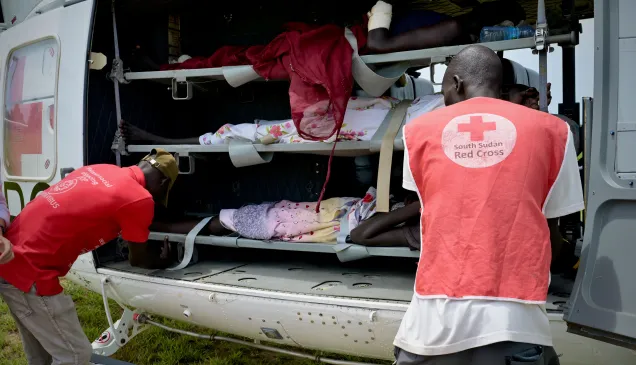
Fighting had reached their home in Jonglei state – one of the areas most affected by the renewed conflict. Kol’s grandmother took him to the nearest functioning health facility, several days’ walk away. From there, he was airlifted over two hundred miles to the ICRC-supported surgical department at Juba Military Hospital.
Between January and June this year, 351 patients were admitted here. Most of them, like Kol, were airlifted in by the ICRC. The projected intake for the entire year – set before the recent escalation in conflict and armed violence – was 400.
Papy Lundoluka, the ICRC’s hospital manager, takes me through the department. We pass along the covered walkways between the buildings. The air is thick and heavy after a morning downpour. The rainy season is underway and won’t let up for months. Patients rest on benches that line the walkway. Others shuffle past on crutches.
Lundoluka says that, by patient numbers alone, this is the busiest six-month period of the last seven years. I can see it. I have been here only two hours and have seen two patients arrive on stretchers – a man and a child, both with gunshot wounds.
As we speak, Lundoluka’s phone rings. He steps aside to answer, face tightening as he listens. According to information received by the team, at least 25 people were killed and 20 others wounded the day before in another state. The decision is made quickly – we must bring the wounded to the surgical department, eighteen of them, tomorrow. He must cut our conversation short.
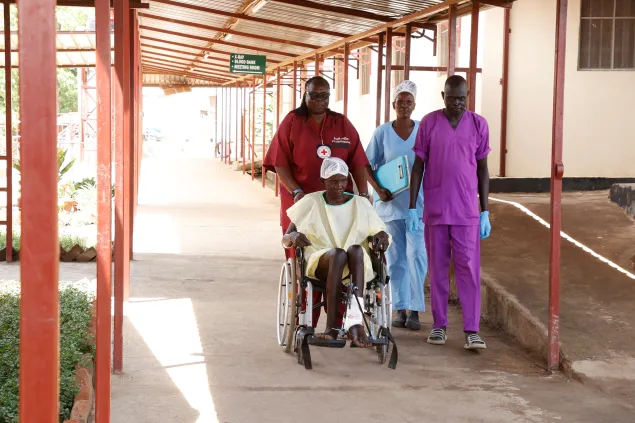
Staff at the ICRC-supported Juba Military Hospital provide patients with all the care they need to recover fully
Since 2014, the ICRC has evacuated more than 5,000 patients from across South Sudan for life-saving surgery, often aided by South Sudan Red Cross volunteers drawn from the communities they serve. The system that supports them — the aircraft, the medics, the multiple wards — is stretched thin.
Casualties are increasing. Medical facilities are limited. Here is a crisis that draws little attention beyond its borders. But standing in this department, one of the country’s main trauma referral centres, the imbalance is impossible to ignore. “The last few months have been very busy, far more so than in previous years. It just keeps getting worse,” says Paul Abraham, the ICRC’s assistant head nurse. He takes a moment between rounds to speak with me, his voice low and steady.
The ward we are in has been operating beyond capacity for weeks, he says. Yet beds must be emptied to make way for tomorrow’s arrivals. The most stable patients will be moved to the overflow tents outside. Ceiling fans churn the smell of disinfectant around the room.
Heavy rain drums against the roof. Beside us, nurses hoist a young man from the bed onto a gurney and wheel him to the operating theatre.
Infected wounds are common, according to Abraham. In remote areas, insecurity and access constraints can delay evacuations. Phone networks are unreliable. Roads are poor. During the rainy season, some routes become impassable.
Family members sometimes carry wounded relatives for days before reaching a point where evacuation is possible. By then, wounds may be severely infected, and, in the most serious cases, amputation may be necessary.
"Patients might stay for a long time in remote places with no medical facilities. When wounds are exposed to dirt and mud, infection can spread easily. There are no many antibiotics in these places,” he says.
Across the room, a young man lies on a hospital bed, mosquito net half-drawn back. With some difficulty, he shifts his weight from one side of his body to the other. His name is Gum and he has been an inpatient at Juba Military Hospital since October last year. He was shot in the hip, and his wound became seriously infected. Doctors have spent months treating both the infection and the damage to his bone and internal organs.
Gum tells me how he was shot during fighting in Warrap state. He lay unconscious and bleeding until local authorities took him to a nearby clinic. “This has had a big impact on me mentally. I felt hopeless, but slowly I’m recovering.” For wounded patients like Gum, recovery is a long, sometimes difficult process.
“It’s heartbreaking. We see men, women, children who have been shot. The bullet doesn’t discriminate,” Majok adds. Behind many of the cases treated here is a critical question: whether wounded people can be reached, evacuated and brought safely to medical care.
For medical teams here, respect for the rules of war is far from an abstract legal principle. I leave Juba Military Hospital as another downpour approaches. I think of Kol and Gum, the nurses, doctors, and the wounded who will arrive tomorrow. The ward will fill again, but the resolve of those who stay to help won’t falter.
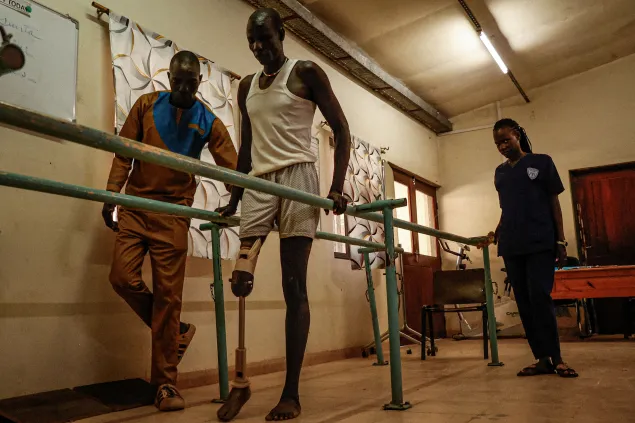
For patients who must be amputated, the process of recovery often includes a referral to the ICRC-supported Physical Rehabilitation Center, where they recieve artificial limbs to restore their mobility and functionality
Under international humanitarian law, all parties to a conflict must respect and protect healthcare personnel and medical facilities, collect and evacuate the wounded and sick without adverse distinction, ensure access to life-saving medical care, and allow humanitarian assistance to reach those in need.