Statement

Upholding Humanity in War: Global Initiative to Galvanize Political Commitment to International Humanitarian Law

红十字国际委员会副主席在北京大学发表演讲

Keynote speech delivered by Jürg Lauber, Vice President of the International Committee of the Red Cross, at Peking University School of Law, China, on September 21, 2026.

Dear scholars and students,

It is my great honour to be here today in Peking University, one of the oldest and most prestigious universities in China. I want to express my gratitude to the university and the law school for making this lecture possible.

This is my first time to visit Peking University, and I can feel the weight of its academic excellence and the depth of its history. There is something truly remarkable about being in a place that has, for generations, brought together great minds, shaped ideas, and contributed so profoundly to the advancement of knowledge in China and around the world. 

World leaders, politicians, diplomats, thinkers and peacemakers often start their journeys in educational institutions like this one. Each of you here today are at the start of that journey and will play a role in shaping the world in the years and decades to come.  

The International Committee of the Red Cross (ICRC), the organisation I proudly represent today, was born in 1863 when a businessman by the name of Henry Dunant saw the horrific suffering of wounded and dying soldiers left without adequate medical care after the Battle of Solferino. What he witnessed moved him to action and to a profound conviction that humanity must prevail even in war. 

It was from this conviction that the International Red Cross and Red Crescent Movement was born. Shortly after, the first Geneva Convention was adopted, which made it compulsory for armies to care for wounded soldiers no matter what side of the line they fought on. 

Today, the International Red Cross and Red Crescent Movement is the largest humanitarian network in the world. 

The ICRC has operational footprint in more than 90 countries, working on humanitarian issues and delivering humanitarian assistance in situations of armed conflict. We work in some of the harshest and most restricted areas around the world. This is only made possible because of our core fundamental principles, especially our neutrality, impartiality and independence. They allow the ICRC to speak to all parties of an armed conflict and to offer humanitarian assistance without distinction. 

The ICRC is one of the few remaining organisations with operational footprint in places like Gaza, Afghanistan, Yemen and Myanmar. 

Last month the ICRC visited Daw Aung San Suu Kyi in detention as part of its ongoing detention work in Myanmar. 

The ICRC’s unique role as a neutral intermediary enabled us to facilitate the release, transfer and repatriation of detainees and hostages in places like Yemen and Gaza. This critical work can only be carried out if our principles and mandate are respected. 

Since its inception, the ICRC has worked tirelessly to protect and assist  people affected by armed conflict. The Four Geneva Conventions of 1949 expanded the legal protection to civilians in times of war, and outlined a mandate for ICRC’s action during armed conflict. 

With the adoption of additional treaties, international humanitarian law has become one of the most codified branches of public international law. The IHL rules have become much more detailed and precise to limit the weapons, means and methods of warfare and to ensure protection and humane treatment to victims of armed conflicts.

Last month, the Four Geneva Conventions turned 77. Having been ratified or acceded to by all states around the world, the Geneva Conventions have been fundamental in protecting people affected by armed conflict for nearly three-quarters of a century. 

International humanitarian law lays out clear and unambiguous rules that apply to all parties to conflict. When upheld, these rules save lives and alleviate suffering. This includes sparing civilians and the infrastructure they rely on like hospitals from attack. Treating those who are captured and detained humanely. Caring for the wounded and sick, and ensuring civilians receive humanitarian aid.

Despite the promise made by states to limit suffering in war, international humanitarian law today is under immense strain. 
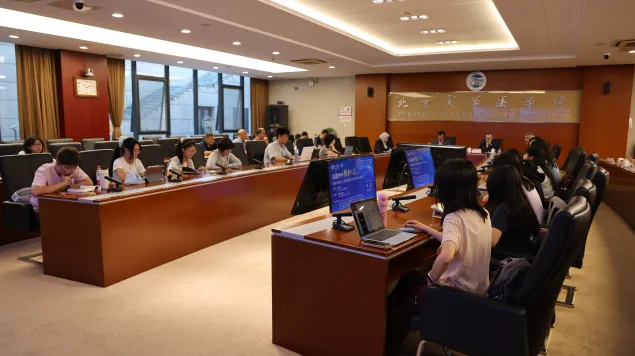
红十字国际委员会副主席在北京大学发表演讲

The ICRC now counts more than 130 armed conflicts across the world – roughly two times what we counted 15 years ago. 

What we observe in our work is that conflicts often become deeply protracted. With every new conflict, there is a real risk that it will continue for years, or even decades.  

The average length of the ICRC’s presence in its ten largest operations is more than 40 years. That is a powerful reminder that, for millions of people, war is not a temporary interruption to life. It becomes the reality for entire generations who grow up in.

Armed conflicts are also often exacerbated by other crises such as natural disasters, pandemics, climate-related events, economic crises and food insecurity. Many of the countries that are most vulnerable to climate change and least ready to adapt are also experiencing armed conflict. The combination and accumulation of these crises can create a perfect storm, with each crisis making people more vulnerable, depleting resilience of communities further, and making recovery from the previous crisis harder.

At the same time, the rapid development of new and deadly weapon technologies is creating new risks for civilians. Just last month, the ICRC president and the United Nations Secretary General warned that we are dangerously close to crossing a moral red-line: the targeting of humans by machines. They called for states to urgently establish international rules on autonomous weapons systems to maintain human control over life-and-death decisions in war. 

Drones are also reshaping how wars are being fought. Cheap and disposable, drones are reshaping the entire concept of a frontline, stretching it over thousands of kilometres and creating a sense that nowhere is safe. 

Conflicts have also become increasingly urbanised, shifting from open fields where they were historically fought to densely populated cities where the risk of harm to civilians and civilian infrastructure is far greater. 

As humanitarian needs rise because of war, we simultaneously see a rapid shrinking of humanitarian space, through rising attacks on humanitarian personnel and restrictions on humanitarian access. 

As the challenges grow, the world must reassert a strong and effective commitment to respect IHL. 

That is why, two years ago, China, Brazil, France, Jordan, Kazakhstan and South Africa, together with the ICRC, launched a Global Initiative to galvanize political commitment to international humanitarian law. 

Today, 118 states have officially joined this Global IHL Initiative, which is close to two-thirds of all High-Contracting parties to the Geneva Conventions. Approximately 160 states have participated in consultations around seven thematic workstreams in an effort to bridge the gap between the law and compliance on the ground. 

These workstreams include:

  • Good practices to prevent IHL violations
  • National IHL committees
  • The connections between IHL and peace
  • Protection of civilian infrastructure, including a focus specifically on hospitals
  • Information and communication technology
  • Naval warfare

We are encouraged that in these conversations, the majority of states have supported a protective rather than permissive interpretation of IHL. We are releasing an outcome document that shares some of the main findings of these consultations in an effort to support states in improving respect for IHL in practice.

The efforts over the last two years will culminate in a high-level historic conference hosted by the Hashemite Kingdom of Jordan on the 7th of December. The Humanity in War conference offers leaders to reaffirm their state’s commitment to IHL. We hope to see all states that have officially joined the IHL Initiative, including China, represented at the highest possible level. 

The Global IHL Initiative is not about creating new international rules. It is not about revising the rules that exist. It is about bringing a renewed global focus to why these rules matter and why they must be upheld.  

The world you will inherit depends on the choices leaders make today to preserve and uphold these life-saving rules. The signal they send later this year in Jordan is critical and we are thankful to the leadership shown by China to bring the Global IHL Initiative to life.

Dear scholars and students,

If you walk away from this lecture with only one sentence in mind, I hope it is this: IHL matters. It is not merely an academic framework studied in textbooks. Whether these rules are respected or disregarded has life and death consequences for people living through war today and tomorrow.

It is easy to feel helpless in the face of so much suffering today, but you all, as future leaders and decision-makers, have a role in shaping the kind of future we want for ourselves and our children.

I hope it is a future that honours our shared vision that humanity must prevail – even in war.  

Thank you.